Latest News
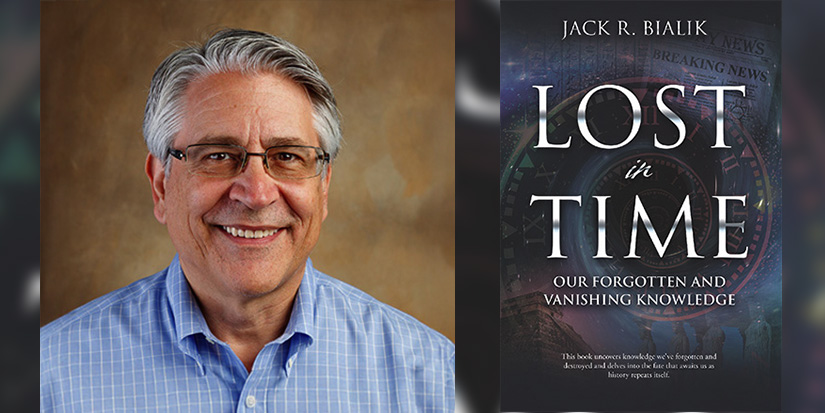
Photo courtesy Jack Bialik
Lost in Time: A Conversation with author Jack Bialik

Published 1:41 PDT, Mon October 19, 2026
Last Updated: 3:03 PDT, Tue October 20, 2026


–
Jack Bialik is a technologist, an engineer, and an author whose career has spanned more than four decades in engineering, information technology, and project management. His latest book is called “Lost in Time: Forgotten and Vanishing Knowledge.”
OCT: This is more than a history book. Your book looks at the question: Have we become too confident in knowledge that once we’ve discovered it, we feel that it can never be lost? Let’s discuss that concept.
JB: Our knowledge seems to be like truth. The truth is always there, and it’s just a matter of uncovering it and finding it. And we seem to do this over and over again in our world and over time. There are so many examples of it—whether they are mechanical or medical. Take, for instance, the fact that we used to do cataract surgery back in 800 BC. Sushruta, a physician in India, did that, and he was well-documented. We have all the books and all the documentation that shows he did that and much more. In fact, he treated diabetes and many more things. But what’s even more interesting is that we were able to do cataract surgery back in 2400 BC in ancient Egypt. We have the Ebers Papyrus that documents that, so a lot of times, whatever we find that we need, we seem to re-find it again and use it again. We live under this modern illusion that linear progress is guaranteed. We think that because we have smartphones and digital repositories, our current understanding of medicine, architecture, and technology is safe. But history tells a completely different story. It reveals a pattern of baseline amnesia where brilliant civilizations reach an intellectual peak, only to collapse or shift, leaving the next generation to start completely from scratch. We don't inherit knowledge automatically; we have to actively preserve it, or it simply evaporates.
OCT: Early on in the book, you talk about inventions, and the one that stands out is the example of Henry Ford and the modern-day assembly line with the Model Ts. This moved us into a new era, but then you start citing examples going back in history, explaining that it was done long before then—for example, the Gutenberg press, possibly one of the greatest inventions of all time, in 1455.
JB: We keep finding examples of this, and it was just recently announced in Germany that they were doing some research and they found a factory from 125,000 years ago. This is in Neumark-Nord, Germany, and researchers found a fat factory where Neanderthals systematically crushed cooking bones to release marrow and nutrients. They made a factory for fat because they needed it to live. We’ve done things so long ago, and it’s because we needed them to exist. Fat was important back then, and a big nutrient and a good way to get heat and keep the body moving. It’s amazing what we find that we’ve done before. When we look at Henry Ford or Johannes Gutenberg, we treat them as starting points, but they were actually reinventing mass-production concepts that human intelligence had already deployed millennia prior. The specialized processing lines at Neumark-Nord prove that whenever a species faces extreme environmental pressure or high resource demand, the logistical answer is always optimization and standardization. We are wired to build assembly lines; we just keep forgetting that we’ve built them before.
OCT: There’s another chapter called "Lost Libraries," and it discusses one of the great iconic libraries in history, which was the one in Alexandria. And when an earthquake, fire, plague, religion, or tyrants happen, and you lose a library, there are giant sections of humanity and history that are wiped out.
JB: It’s estimated that 400,000 scrolls were lost in the fire in 391 AD, and you can imagine what was in there. But we do this over and over again. During the war in Iraq, with the Baghdad museums, we lost 1 million artifacts due to the war there. Think about the sheer density of human experience contained within those spaces. In Alexandria, it wasn't just poetry or stories that burned; it was advanced geometry, architectural blueprints, geographical maps, and medical texts. When those repositories vanish, the cultural and technological baseline drops instantly.
OCT: You state that 1.6% of human history is recorded in some form. That is astoundingly low.
JB: We have examples all over the world where things have been done, and we don’t know how they were accomplished. We have theories like the pyramids at Giza because we see them, and there are three of them there, and we can imagine how they might’ve made them, but we don’t know exactly how they were made. I believe there is a library, and there are some indications and people have looked for a library around the pyramids. But the problem with time capsules is we lose them. There’s a very famous example of that. George Washington buried one at the White House in 1793, and it was never found. If you look it up and just do a search, you can find all kinds of time capsules that were buried and lost. This 1.6% metric should humble us. It means that the vast majority of human genius, struggle, engineering, and cultural triumph has left no trace behind. We look at massive monolithic structures like Stonehenge or the monuments in South America and try to reverse-engineer their construction methods using our own logic, completely missing the unique methodologies the builders actually used. We think we can safeguard our own era by burying objects or digital drives, but time capsules are notoriously terrible at surviving. If a foundational cornerstone laid by George Washington himself under the oversight of the federal government can vanish from history, what hope do our temporary digital formats have?
OCT: Another great line in your book is, “Rediscovering ancient knowledge is like retaking the history class that you realize how much you forgot what you learned.” As human beings, that’s something we are really good at is forgetting what we know.
JB: Humanity does that. It gets lost; languages get lost, sewing skills, and all sorts of things. It’s all being done by machines today. It gets lost.
More information at LostinTime.world
















2 Hours of free financial consulting
Jai Xin Planning Ltd.
C$120.00 C$0.00

Use any of our home staging service and get a second month rental for free!
MiiX Interiors
C$500.00 C$0.00

Get 10% off any order
Phantom Screens Lower Mainland
C$200.00 C$180.00